

Going Beyond the Standard Limits
CoaXPress Equalizers Gen2
With the introduction of CXP-10 and CXP-12 speeds in CoaXPress standard v2.0, Camera and Frame Grabber manufacturers had access to higher speed-grade components like cable drivers and equalizers to be able to reach up to 12.5 Gbps. This second generation of components has a better sensitivity to retrieve the serial data from highly attenuated signals. A side effect of this new generation of components is that we can support longer cables at CXP-1 to CXP-6 speeds in comparison with the first generation of CoaXPress equalizers. Euresys, for example, has validated systems running at CXP-6 over second-generation equalizers with 72 m of cable, which is 140 % more cable length than it is defined by the CoaXPress Standard.
The reason for the difference between the maximum attenuations defined at CoaXPress standard for CXP-1 to CXP-6 speeds and the ones obtained with second-generation components is due to the off-the-shelf experience proposed by CoaXPress. A certified CoaXPress cable must interoperate with any generation of CoaXPress components and in the case of the example with 72 m of cable at CXP-6, the same cable is not supported by first-generation CoaXPress equalizers.
Systems that leverage the better sensitivity of second-generation components must employ custom cables instead of off-the-shelf ones. These custom cables require functional validation by the system integrators along with the camera and frame grabber manufacturers.
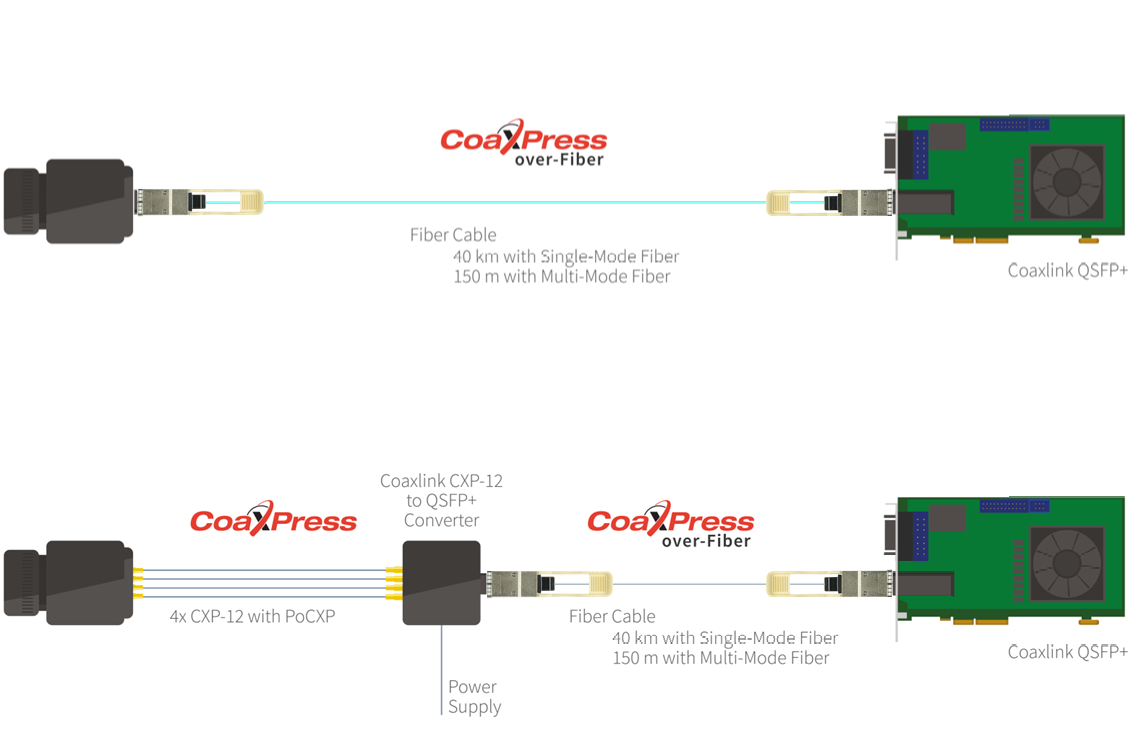
CoaXPress-over-Fiber
The most economical solution for long distances is to use fiber optics as transmission medium. Fiber cables are much lighter, thinner, less expensive than coax cables, and can deliver very high bandwidths over very long distances.
With the introduction of CoaXPress-over-Fiber as an extension of the CoaXPress standard, we have an easy solution to go beyond the cable lengths for coax as defined in the standard. Note that the use of fiber has other advantages like less cable congestion, EMI immunity, and higher speeds, but these topics are out of the scope of this article. Note also that it is not possible to supply power via fiber cables as in the case of PoCXP via coax cables.
There are two fiber solutions to go beyond the maximum lengths of coax cables. The first one is a system fully based on the CoaXPress-over-Fiber standard where both camera and frame grabber are compliant with the standard and interconnected directly via fiber. The second solution is via a converter that can interface a CoaXPress camera based on coax cables to a CoaXPress-over-Fiber frame grabber. Both solutions allow us to use the full range of fiber cable lengths, going from few meters to tens of kilometers.