


Isolated Input (Version 2)
Applies to PC1628 Grablink Duo, PC3623 Coaxlink Quad CXP-12 Value, PC3624 Coaxlink Quad CXP-12 DF and PC3633 Coaxlink Quad CXP-12 3D-LLE.


Isolated current-sense input with wide voltage input range up to 30V, compatible with totem-pole (push-pull) HTL drivers, 5V TTL/RS-422 differential line drivers, 5V CMOS drivers, potential free contacts, solid-state relays and opto-couplers
|
|
|
|
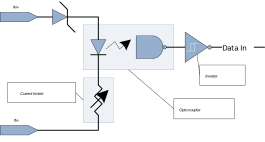
Simplified schematic |
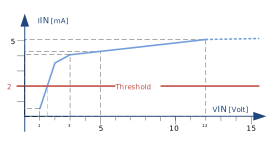
Input Current vs. Input Voltage Characteristics |
DC characteristics
| Parameter | Conditions | Min. | Typ. | Max. | Units |
|---|---|---|---|---|---|
| Differential voltage | -30 | +30 | V | ||
| Input current threshold | 2 | 3 | mA | ||
| Differential voltage | @3 mA | 2.2 | V | ||
| Input current | @(VIN+ - VIN-) < 1 V | 0.5 | mA | ||
| @(VIN+ - VIN-) = 3 V | 4.1 | mA | |||
| @(VIN+ - VIN-) = 5 V | 4.4 | mA | |||
| @(VIN+ - VIN-) = 12 V | 5.1 | mA | |||
| @(VIN+ - VIN-) = 30 V | 6.8 | mA |
AC characteristics
| Parameter | Conditions | Min. | Typ. | Max. | Units |
|---|---|---|---|---|---|
| Positive pulse width | 2.5 | µs | |||
| Negative pulse width | 2.5 | µs | |||
| Pulse rate | 0 | 200 | kHz | ||
| Turn-ON delay1 |
25 °C; 100 kHZ; 5 V square signal (LineFilterDelay = 500 ns) |
800 | ns | ||
| Turn-OFF delay2 | 1350 | ns |
| 1. | The "Turn-ON" delay is defined as the time difference between a transition of state at the input that turns ON the opto-coupler and the subsequent transition in the FPGA. |
| 2. | The "Turn-OFF" delay is defined as the time difference between a transition of state at the input that turns OFF the opto-coupler and the subsequent transition in the FPGA. |
| 3. | The response of the Isolated I/Os vary in function of the activation frequency. It appears that the variation is caused by a variation on temperature: Higher is the frequency, higher is the temperature, witch increases the propagation delay. |
These delays include the delay introduced by the digital line filter controlled by the LineFilterStrength GenApi feature!
Isolation characteristics
| Parameter | Value |
|---|---|
| Isolation grade | Functional |
| Max. DC voltage | 250 V |
| Max. AC voltage | 170 VRMS |
The functional isolation is only for the circuit technical protection. It does not provide an isolation that can protect a human being from electrical shock!
Logical map
The state of the port is reported as follows:
| Input current | Logical State |
|---|---|
| IIN ≥ 3 mA | HIGH |
| IIN < 0.5 mA | LOW |
| Unconnected input port | LOW |
Compatible drivers
The following drivers are compatible with this version of the isolated current-sense inputs:
| ● | Totem-pole (push-pull) HTL drivers, 5V TTL/RS-422 differential line drivers, 5 V CMOS drivers |
| ● | Potential free contact, solid-state relay, or opto-isolators |
| ● | 12 V and 24 V signaling voltages are also accepted |
| □ | The +12 V power supply on the I/O connector(s) can be used for powering drivers requiring a power supply. |
| □ | No external resistors are required. However, to obtain the best noise immunity with 12 V and 24 V signaling, it is recommended to insert a series resistor in the circuit. The recommended resistor values are: 4.7k Ohms for 12 V signaling and 10k Ohms for 24 V signaling. |
See also: Using Isolated Inputs